
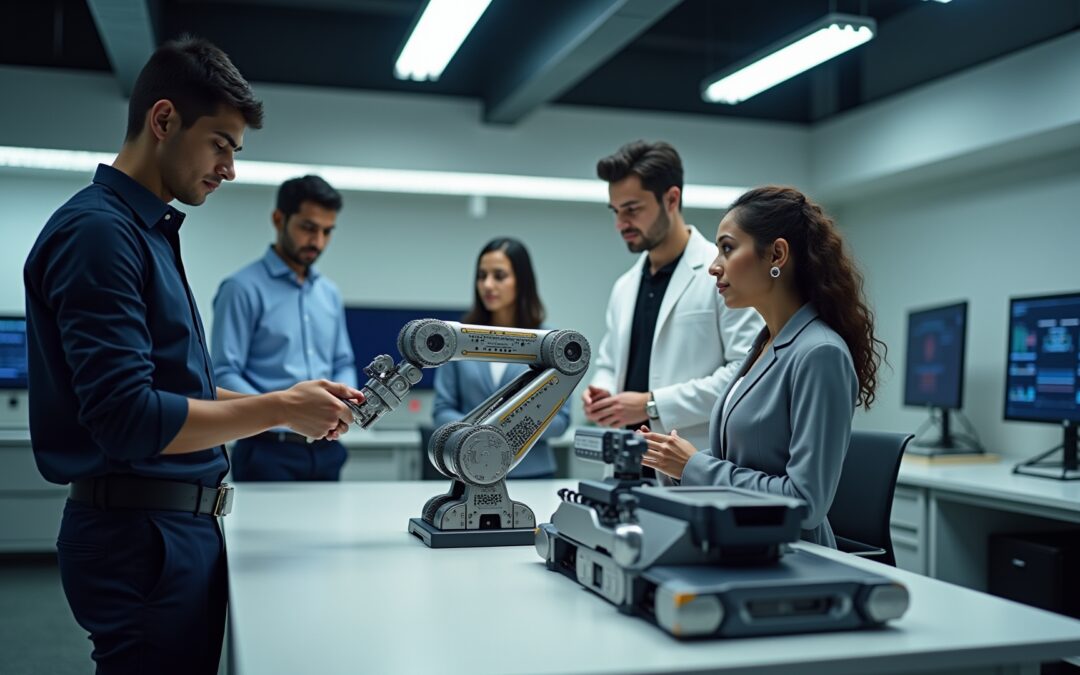
You’re witnessing a pivotal shift that could redefine the contours of edtech skilling and workforce readiness in India. Mafatlal Industries’ recent securing of an INR 114 crore contract to deploy 500 robotics labs across Odisha is not just another infrastructure rollout—it’s a strategic marker for how technology, policy, and education sectors are converging to shape the future of employability. If you lead an edtech company, run a learning platform, or influence workforce development, this bold initiative directly impacts your understanding of scalable, impact-driven digital education.
Why This Matters to You
For businesses and institutional leaders invested in edtech and digital skilling, the Odisha robotics labs project illuminates the critical value of experiential, competency-based education in emerging markets. It highlights how regional penetration—beyond metro hubs—is becoming indispensable for long-term growth and impact, especially in India’s tier 2 and tier 3 cities. Moreover, it presents a replicable model for public-private partnerships that elevate skill development aligned with industry needs.
In your workforce strategy or edtech product development, understanding this initiative is essential because robotics and AI-enabled learning are no longer niche. They form the backbone of future-ready talent ecosystems capable of meeting automation-driven economic demands. Odisha’s labs show you how hands-on technology integration can transform traditional educational paradigms, making learners more employable and adaptable.
What Is Happening?
Mafatlal Industries has been commissioned by the Odisha Computer Application Centre (OCAC) to implement 500 state-of-the-art robotics labs across the state’s schools—an investment of approximately INR 114 crore. This is not merely a volume contract but a strategic move to embed advanced STEM education through robotics, transitioning students from rote learning to an immersive, skill-based pedagogy.
The labs will serve as interactive hubs where students engage with robotics, automation, and AI applications, laying a foundation for tech fluency and innovation mindset crucial for the fourth industrial revolution. For edtech leaders, this initiative exemplifies a growing trend: blending physical infrastructure with digital curricula to enhance learning outcomes and employability skills.
Key Business and Market Implications
The initiative’s business significance lies in its demonstration of public-private synergy driving edtech expansion in underserved regions, backed by robust government policy frameworks like India’s National Education Policy and Digital India drive.
- Scale and Sustainability: Mafatlal’s robotics labs model offers a blueprint for scaling educational tech that balances physical infrastructure investment with digital content and effective teacher training.
- Regional Market Expansion: This project signals a deliberate move to activate digital learning hubs in non-metro regions, presenting opportunities for edtech firms targeting tier 2 and tier 3 cities.
- Outcome-Centric Learning: Emphasizing robotics-based STEM education moves you away from purely theoretical knowledge towards competencies that employers highly value.
- Policy Alignment: Such initiatives showcase how business leaders can leverage government schemes for digital literacy and AI-skilling to expand their footprint and impact.
“When technology, pedagogy, and employability align, edtech growth becomes far more durable.”
Deep Strategic Insights
For you as an edtech innovator or investor, Odisha’s robotics labs underscore critical shifts in how skilling solutions must be designed and delivered.
- Hybrid Physical-Digital Models: The future of effective edtech lies in hybrid models combining tactile, hands-on experiences (like robotics labs) with AI-enhanced personalized learning pathways—critical for engagement and retention.
- Localized, Inclusive Skills Ecosystems: The focus on Odisha is a case study in regional inclusion. To build sustainable businesses, you must adapt to linguistic and infrastructural diversity, tailoring products that work within local ecosystems.
- Measurable Employability Outcomes: Leadership demands extend beyond access to education—they seek verifiable skills that translate into workforce readiness, which robotics and experiential STEM education directly support.
- Public-Private Partnership Leverage: Collaborations like that between Mafatlal and OCAC point to a viable pathway for mobilizing capital, technology, and policy alignment to drive systemic change.
“In education, scale matters — but meaningful outcomes are what build lasting trust.”
Practical Takeaways for EdTech Leaders and Investors
- Understand the value of multimodal learning: Invest in combining hands-on tech labs with AI-enabled digital learning to improve long-term user engagement and skill demonstration.
- Explore regional markets aggressively: Monitor government-funded infrastructure projects in tier 2 and tier 3 cities as fertile ground for product piloting and scaling.
- Align with policy initiatives: Engage with national frameworks like NEP 2020 and Digital India for funding and strategic partnership leverage.
- Invest in teacher and institution enablement: Infrastructure alone isn’t sufficient—ensure ongoing professional development and curriculum integration for maximum impact.
- Measure skilling outcomes rigorously: Develop and use metrics that link learning interventions to actual employability indicators to demonstrate value to stakeholders.
Risks and Operational Challenges
You must be aware that deploying robotics labs at this scale comes with inherent execution risks. Maintaining technology infrastructure, sustaining teacher training, ensuring curriculum alignment, and adapting to local ecosystem constraints require continuous management effort. Misalignment here can dilute impact and threaten the sustainability of similar projects.
Additionally, measurable impact on employability outcomes depends on integrating these skills into broader workforce development frameworks, which may need cross-sector collaboration beyond education alone.
What Should You Watch Next?
Keep a close eye on how this initiative evolves in Odisha, particularly the following:
- The effectiveness of teacher training programs in leveraging robotics labs.
- Adoption rates of robotics-enabled STEM curricula across schools.
- Government and private sector collaboration models emerging from this project.
- Expansion of similar hybrid edtech infrastructure projects in other regional markets.
- Measurable improvements in student employability and skills readiness tracked over time.
Conclusion
Mafatlal Industries’ INR 114 crore partnership with OCAC to set up 500 robotics labs in Odisha serves as a powerful case study for how you can harness technology-driven skilling initiatives to reshape education and employability landscapes. This initiative goes beyond infrastructure—it is a strategic blueprint for aligning education delivery with the demands of a technology-driven economy, fostering regional inclusion, and driving sustainable, outcome-focused edtech business growth.
For you as a leader, investor, or innovator in the edtech and skilling space, Odisha’s robotics labs provide tangible lessons on how to build future-ready learning ecosystems that multiply impact, scalability, and long-term competitive advantage.
“The real edge is not only in delivering content, but in helping learners convert knowledge into opportunity.”